

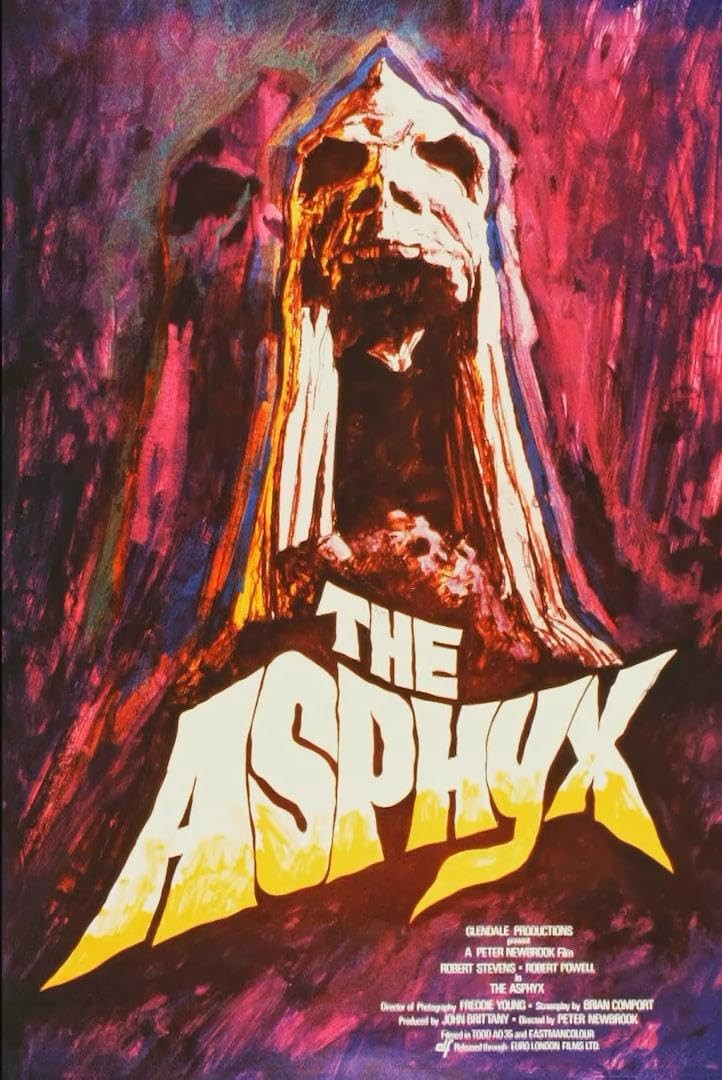
The Asphyx (1972) is the movie for this Sunday’s “monsterdon” watch party over on Mastodon, our fediverse sibling!
- Just start watching that movie this Sunday, November 30th at 9pm ET / 8pm CT / 6pm PT which is 2am Monday UTC
- and follow #monsterdon over on mastodon for live text commentary. For example, you can follow that hashtag here: https://mastodon.social/tags/monsterdon
- I usually open two web browser windows side-by-side on a computer. But you could follow the mastodon commentary on a phone app while watching the movie on TV or something.
How to watch the movie:
- RUNTIME NOTE: online sources have slightly different runtimes, possibly because this movie had 4 different DVD/Bluray releases over 12 years, so runtimes are given below
- tubi (availability varies by country) (1:26:31): https://tubitv.com/movies/100022435/the-asphyx
- youtube (1:23:12): https://www.youtube.com/watch?v=lkgEwnFOrg8
- uBlock Origin adblocker on Firefox should work for those tubi and youtube links
- dailymotion: (“with deleted scenes”) (1:38:48) https://www.dailymotion.com/video/x9bny1u
- dailymotion: (1:22:17) https://www.dailymotion.com/video/x9q7pew
- archive: (1:22:17) https://archive.org/details/the-asphyx-1972
- someone usually streams it on https://miru.miyaku.media/ at that time.
- if you want to pay and/or watch ads, look here: (1:39:00) https://www.justwatch.com/us/movie/the-asphyx
Asphyx refers to the Ancient Greek word asphyxía, meaning “lack of pulse”, or English asphyxiation.
In Victorian England, philanthropic scientist Sir Hugo Cunningham is a member of a parapsychological society that studies psychic phenomena. As part of their latest investigation, the men have been photographing individuals at the moment of death. The resultant photos depict a strange smudge hovering around the body. Though the society concludes that they have captured evidence of the soul escaping the body, Cunningham is skeptical. ……
The Monthly Film Bulletin wrote: “After a promising opening which involves some evocative glimpses of Victorian ‘psychical research’, The Asphyx soon changes course to become a very static account of Hugo’s growing obsession with immortality. The film is not helped by Robert Stephens’ highly theatrical Hugo, or by a script which abounds in clichés and facile explanations while relegating the invention of the cine-camera to a minor parenthesis. The rest of the cast cope as well as they can, with Robert Powell giving a characteristically authoritative performance as Giles, but the script eventually defeats them. The idea of the Asphyx – nicely visualised in the elaborate experiments as a writhing, screaming shadow – is never sufficiently developed to succeed in being exciting; and the film emerges as an unrewarding endurance test, periodically enlivened by some of the non-dialogue sequences.”[4]
Budd Wilkins from Slant Magazine awarded the film 3.5 out of 5 stars, writing, “Not quite a genre classic, The Asphyx is a mostly intriguing mashup of Victorian ghost story and steampunk revisionism that occasionally threatens to degenerate into inanity with its strident morality-play storyline and escalating improbability factor.”[5]
Brett Gallman from Oh the Horror gave the film a positive review, calling it “an old fashioned, cathartic tragedy with familial bloodshed, played in garish fashion and with the moralizing pathos of medieval drama.”[6]
Stuart Galbraith IV from DVD Talk awarded the film 3.5 out of 5 stars, praising the film’s cinematography and lighting while criticizing its “clunky” dialogue, stagy blocking, and low budget.[7]
Bob Brinkman from HorrorNews.net gave the film a positive review, saying it “conjures a feeling of existential angst as it wrestles with some of the darker philosophical thoughts of life, death, and immortality. With a twist towards the end of the story that is not a gimmick, but instead a well-turned bit of grief-filled misdirection, this is a must see for fans of gothic cinema.”[8]
TV Guide gave the film a mixed 2/5 stars, writing, “An unusual horror movie with an intriguing premise, The Asphyx is unfortunately marred by a weak script and unimaginative direction.”[9]
On Rotten Tomatoes, the film holds an approval rating of 67% based on 6 reviews, with a weighted average rating of 5/10.[10]
The movie’s main theme is pretty cool