If the non-food products (which account for about 40% of the animal) are accounted for, the food-CO2 falls by ~40% to about 51.
This doesn’t seem to take into account methane production and its effect on the climate either, which would probably put cows and pigs much higher.
Right. Cattle produces a lot more than just beef. Leather, horns, bones, and hooves are additional products that come from the cow. Then there’s all the animal feed and plant fertilizer that come from the less desirable parts of the cow. I wonder what the carbon footprint is when the entirety of the cow is taken into account. No part of the animal is wasted during rendering.
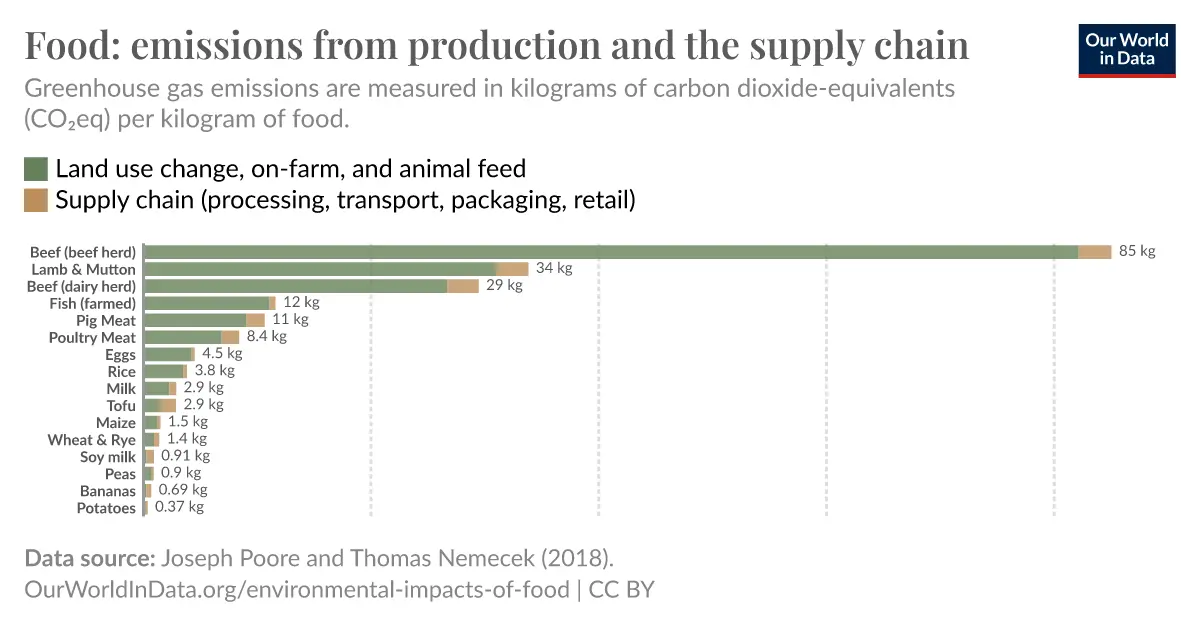
Another “fun” chart on various food sources green house gas emissions adjusted per kilogram of food product.

I love how the chart breaks cows into multiple categories making it look that much smaller even though it’s still chart topping.
Edit: Oddly enough they’re citing the same data in both the one I link and OP’s link.
Why is Kilograms of food product the one axis? shouldn’t it be kcals or something?
https://ourworldindata.org/grapher/ghg-kcal-poore
They have that too. Beef is still the worst by a huge margin
poore nemecek’s methodology is flawed.
What’s wrong with it?
the paper tries to quantify all the inputs and outputs for foods, but it fails to actually calculate either the actualy outputs (like non-food animal products), or the actual costs of the inputs (many of which would be waste products)
if you total all the inputs that go into a product (the water, the carbon emissions, the land use, etc), then you can see what it would cost to produce it if you made no other products. but that’s not actually the environment in which meat dairy and eggs are produced.
the most illustrative example is cotton. cotton is not a food. it is grown for textiles. it wrecks the soil and it is THIRSTY. after you harvest the cotton and separate the fiber from the stalk and seed, you have seed left over. way more seed than you need to replant. cottonseed can be and is pressed for oil, but it takes much less processing to mix it into cattle fodder. why should the water used to grow cotton count against the water inputs for beef and milk? it’s actually a conservation of resources. these industries are all interconnected, and trying to just put a singular value on every product in the absence of the context of its production is not actually useful in determining what would be ecologically responsible.
The paper is a meta-analysis, it’s not trying to calculate those things at all. It’s collating and standardising the results of other studies doing that. To take Ridoutt et al 2011 as an example because it’s the first beef one that comes up in the dataset, regarding feedlots:
In the feedlot subsystem, water and energy use was calculated using data reported in a benchmarking study of Australian beef cattle feedlots (Davis and Wiedemann 2009). The composition of the feedlot ration was based on detailed, multi-year records provided confidentially by a large feedlot operator. Consumptive water use associated with the production of each feed component was calculated using national statistics (ABS 2008a,2008b) and various CSIRO data sources (e.g. Ridoutt and Poulton 2010). The EcoInvent v2 database (http://www.ecoinvent.org) was the source of water use information for mineral supplements (<0.01% by mass). The feedlot operator also provided data on the transportation distances of the feed components which were used to calculate fuel use in transporting commodities to the feedlot.
It’s depending on the work of the 1,530 source papers to calculate the inputs appropriately. You would know this if you had looked at the paper, so where did you get the idea that it is as you described?
the conclusion is “beef produces 85kg co2e”. it’s calculating exactly what I said.
That would also be a very nice comparison and honestly probably a better one given how different food have very different calorie densities.
Now I’m really curious about calorie density of the various categories listed in the chart, I’m probably going to have to do some napkin math to get a small ball park.
I know I won’t be anywhere close to the actual figure but I may be close enough to satisfy my curiosity.
Edit: Thinking about it a bit though brings to mind that the calculations there would be incredibly difficult and would likely require a lot of averages.
You should probably take into account beneficial and harmful effects of each food type as well (including externalities such as healthcare costs), although that would be an even more difficult task.
Though this is a great chart, it isn’t quite the whole picture either for climate impact. Almonds and almond milk get to be a lot worse alternative option if you consider the water consumption concerns where they are grown in California. They have many similar charts that attempt to quantify holistic carbon footprint.
Long story short, though not eating animal products is best for the environment, even just eating beef less often and not worrying about eggs and chickens can get you to over half the climate impact of full veganism and is a much easier transition for some.
poore nemecek had flawed methodology and should not be the basis of policy decisions.
Kindly explain where so we can make our own opinion.
as just one facet, they count everything fed to beef, including cottonseed, when calculating the inputs. but cotton isn’t grown for cottonseed. if we didn’t feed a large portion of our annual cottonseed to livestock, it would just be wasted. vegans will tell you that the return is only 1/10 of the input, but that’s a lot better than 0/10.
it’s basic physics: animal products consume more energy (calories) than they produce in food because they exert energy on living - moving, eating, converting food to energy, etc.
Eating a plant directly (or with comparable processing to meat) means less wasted energy (as in calories burned compared to calories produced as food) simply because you’re going one step higher (lower?) in the food chain to obtain that energy.
brb, adapting my digestive system to directly extract energy from rocks.
Would it make more sense to compare based on calories and not weight? Since you need to eat more tofu than beef for the same calorie intake. If my math is right, tofu is about 760 kcal per kg while beef is 2500 kcal per kg so that makes it ~34 grams of CO2 per kcal for beef and ~3 grams of CO2 per kcal for tofu.
Definitely tofu is still better obviously, just wanted to compare with that metric. Not sure if it makes more sense or not.
The website has a graph for that and for protein as well. It’s pretty neat
I don’t like tofu. I like other meat substitutes but idk tofu is not the greatest comparison to meat in my opinion
I always find the comparison between tofu and meat a bit unfair, as it wasn’t invented for that purpose. In many asian cultures it is simply a thing in its own right, only we in the West have popularized it as a meat substitute and I don’t think that does tofu justice.
yea it is just another type of food,you like it or don’t
other meat substitutes
Tofu is not a meat substitute. Tofu is just tofu, unless someone specifically picks it as a substitute for meat and sticks to it, in which case I guess it’s their personal substitute for meat.
Tofu is not a meat substitute.
Correct, however I believe it has been commonly accepted as a such because of its protein content… just clarifying what I think people mean here
I didn’t realize that there was a direct correlation between CO2 expenditure during food production and the final product’s flavour
Isn’t air travel and large ships far worse for the environment? I don’t mean to derail a conversation, but I suspect that air travel and ocean liners have a significantly bigger impact and I don’t see as much coverage on that issue.
Fortunately, we have a series of tubes connecting every computer on the planet that can help answer questions like this!
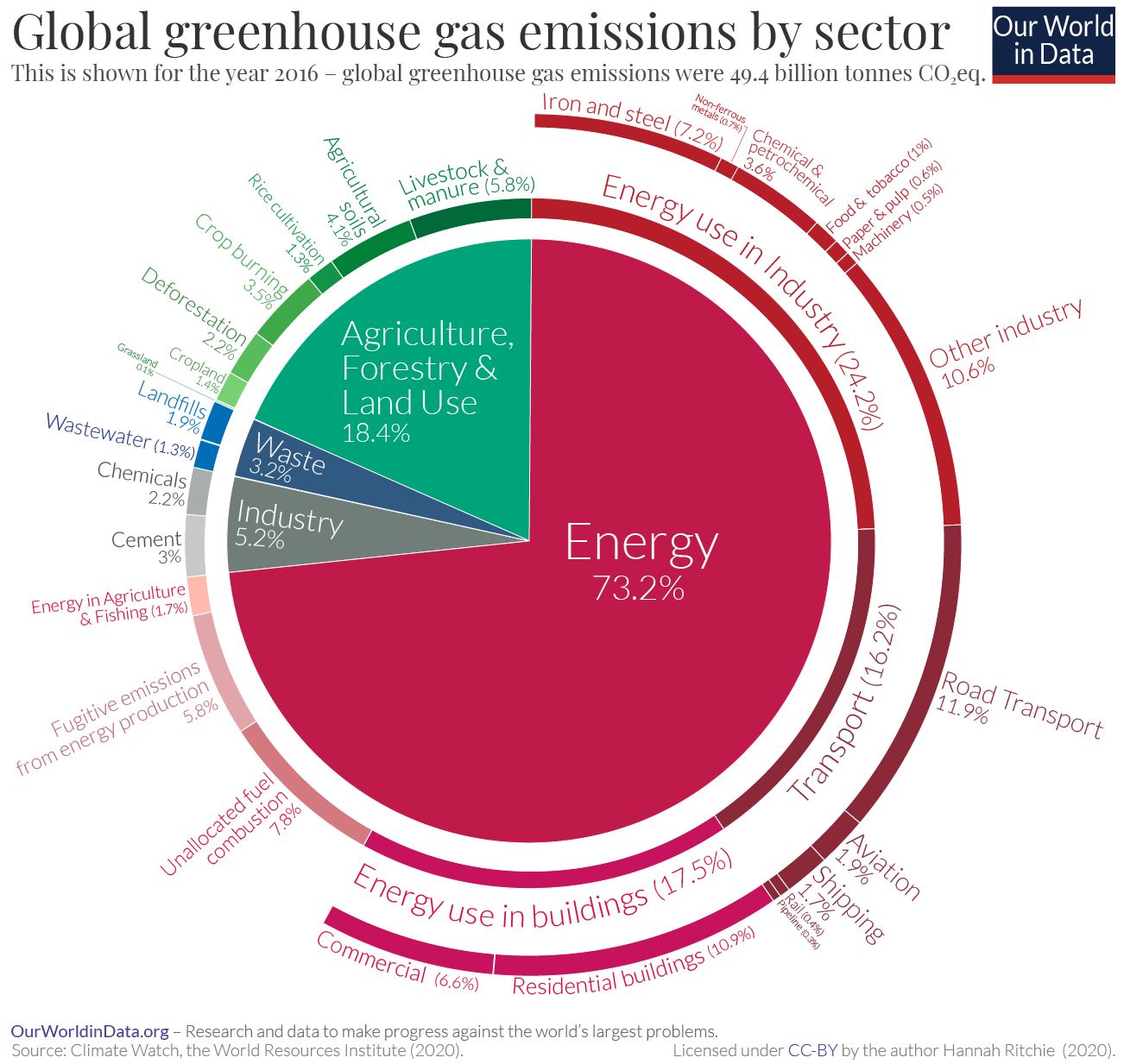
In short Aviation (1.9%) and Shipping (1.7%) are smaller than Livestock & Manure (5.8%) even before factoring in the secondary impacts that are largely driven by the livestock industry, like land use change, soil loss, and deforestation.
If you’re specifically talking about transportation emissions for food, there’s a graph for that as well!

Supply chain represents ~18% of the overall food footprint, smaller than livestock and land use changes.
Talking meat specifically, the transportation emissions are a tiny piece of their overall footprint, as is shown in the OP.
Damn these charts are nicely made.
Agriculture makes up a full quarter of our total emissions. Some of that is because of shipping it, of course, but there is absolutely no question whatsoever that agriculture is a huge contributing factor to climate change
Data about greenhouse emissions from transportation is talked about more frequently than any other source in my experience. I don’t see the relevance to this data as beef and tofu can be produced locally or shipped overseas, so the emissions to produce the product would be a separate discussion versus emissions in transit.
I don’t see as much coverage on that issue.
No, there’s plenty of coverage. If anything, there isn’t enough coverage on animal agriculture because people can’t fathom a world where they don’t eat meat (or even just significantly reduce their consumption).
You are not derailing, you are putting the topic back on track.
We can talk about both issues, as I think they are both important, but I suspect that the larger issue is being ignored because it threatens establishment interests.
This dude’s puns are seriously underrated
I’m all in for reducing beef consumption, not just because of the green aspect but also health… having said that, this is yet another fool’s errand the masses have been set to follow:
- we could curve global beef consumption significantly by realign massive sectors of the supply chain, agriculture and education OR
- we could get rid of the Kardashian (sp?) that likes to take private jet hops to avoid minutes of traffic
You know who says changing beef consumption is impossible so it’s meaningless to even try? Beef industry spokespeople.
I mean, what’s more impossible - changing Western dietary habits or changing the entire structure of capitalism and representative democracy that allows rich people to own private jets?
I mean, what’s more impossible - changing Western dietary habits or changing the entire structure of capitalism and representative democracy that allows rich people to own private jets?
I don’t know, do you?
All I’m saying is eliminating bad habits from literally a few individuals would have a greater effect than curving the habits of millions
I mean, what are you? A spokesperson for Boeing?
deleted by creator
From a quick glance, it seems they didn’t consider emissions coming from exporting kangaroo meat abroad. Though I fancy the total will still be way lower than the alternatives.
deleted by creator
And it’s cheaper. I remember in 90s Australia helped Russia not to starve by exporting kangaroo meaty
deleted by creator
It used to be the cheapest legal meat you can get in Russia.
Edit: it was also added in soldiers rations during Afganistan campaign
The biggest difference here is not related to the animals themselves, but the scale.
Much of beef’s emissions has to do with land use changes and diet which are both a necessary (but unfortunate) part of managing 1.5 billion cows to serve as a primary protein source for billions of people. In comparison, there’s somewhere on the order of 30 million kangaroos on the planet (2% of the number of cows) and I’d wager the overwhelming majority of them are wild, not farmed for meat.
The difference in footprints here shows the differences in management practices and the downside of commercial ranching. If everyone on The planet switched their 0.5 servings of beef per day for 0.5 servings of kangaroos, nothing would be fundamentally different in the environmental outcomes. We’d still be clearing forests in the Amazon, just now it would be for kangaroos.
Sustainable meat consumption is only achieved through dramatic reductions in consumption. People don’t have to quit meat, but it does have to become a thing reserved only for special occasions. Like it or not, the only path to sustainable food consumption requires everyone eating veggies (including the dreaded tofu) most of the time. Getting beef fed things like seaweed increases the portion of yearly meals that can include red meat sustainably, but does not somehow eliminate the fact that there majority of people’s meals need to avoid red meat (sorry folks).
deleted by creator
You have evidence that farming 10 billion+ kangaroos (it would probably have to be closer to 15 billion, based on the weight differences, ~200 lb/roo vs ~2000 lb/cow) can be done without any compounding burdens, e.g., land use changes, increasing the CO2/kg?
Are there a lot of studies in industrial-scale kangaroo farming? I’m very much interested in evidence on how we could sustainably manage and farm tens of billions of animals to feed a global population at today’s levels of meat consumption.
If you’re comparing the footprint of wild caught kangaroos with industrially farmed beef you’re comparing apples to oranges. One cannot be a substitute for the other because they exist on tremendously different scales. Unless of course you have evidence on how we manage wild kangaroos to feed 7 billion people. If you do, please oh please share. I am definitely interested in the evidence!
In not disagreeing with what was presented, that wild caught kangaroo is lower carbon intensity than industrially farmed beef, I’m only disagreeing with the clear implication of that statement and its context; that we could somehow swap one for the other and not have to change our levels of consumption. So please, show me the data on global-population-feeding scale kangaroo farming, I’ll retract my previous statement and issue a formal apology in the Australian Times.
deleted by creator
You’ve got this all so backwards it’s mind numbing. Everything the other person says was correct.
deleted by creator
Can I get some numbers on a bottle of Gochujang sauce?
The carbon that we dig out of the ground and put in the air, that is the ony one relevant to global warming. Everything else is just a change of phases in a cycle.
Yeah but problem is that the methane phase is a much more powerful greenhouse gas than CO2
CO2 in air » plant » cow » methane in air (cow bacteria farts and burps) » CO2 in air
Also carbon sinks around the globe are being replaced by systems that are at best carbon neutral. Every acre of carbon sequestering rainforest cleared to farm cattle is a net decrease in our ability to process atmospheric carbon.
True, add to that CO2 emission for transporting all that animal feed around the world
Why is beef from a beef herd worse than beef from a dairy herd?
I think just because dairy cows live longer. Beef cows are killed younger, you don’t need to wait until their milk production dwindles. It’s not clear if accounting for the milk carbon footprint was taken into account or not.
anywhere that compares by calorie? just curious
Someone shared below, but here you go: https://ourworldindata.org/grapher/ghg-kcal-poore
oops forgot to update comment when I saw that. thanks tho
Don’t forget also that meat products need to be fed calories before you get calories back from them. Look up trophic levels if you want more info, but I believe the rule of thumb is 10x the amount of calories needed for most meat products.
It’s amazing how much food you have to eat when you’re a vegetarian. I went vegetarian for about a year. After my first month I felt like I was dying. Simple things like putting on my shoes left me exhausted. I finally started using a calorie calculator and discovered I was getting about a thousand less calories per day than I actually needed.
I was a banker mason for 10 years before going back to university, carving stone almost every day for years, I went vegan 5 years in and I didn’t experience a sudden drop in energy, I made sure I was getting enough protein and adequate amounts of vitamins (especially b12) either through food groups of vitamins tablets.
Also after not eating beef I haven’t lost any muscle mass, I may be crazy but I think big beef has been lying for decades.
The difference is that you were wise enough to track your calories and macros after the switch.
big beef has been lying for decades
That’s exactly what my ex-wife said.
I freakin love tofu, air frying it is so tasty. I just wish it were cheaper.
Aldi and Fresh Thyme tofu is pretty cheap around me if you have those.
Where I am it’s cheaper than beef, sometimes cheaper than chicken.
So avoid beef, lamb, and mutton, got it.